

Sports like hiking, cycling and trail running demand a lot from the body, especially when activities take place on hot days. During summer, fluid loss through sweat increases significantly, and dehydration can arise faster than many imagine — even in moderate-intensity activities. Proper hydration is essential to maintain performance, avoid cramps, dizziness, blood pressure drops, heat exhaustion and even more serious problems. Additionally, lack of water compromises concentration, motor coordination and decision-making, essential factors for safety in natural environments.
Therefore, choosing the ideal hydration accessory for each modality, activity duration and weather conditions makes all the difference — some options work better for certain sports and are not efficient in others. In this text I will talk a bit more about each of the most common ways to transport water during outdoor activities.
1. Rigid and semi-rigid bottle
These bottles are the most durable options among all the ways we have to carry water during an outdoor activity. Even so, they are not always the best choice for all athletes.
We can divide them into two main groups: metal or plastic bottles. Each type has advantages and disadvantages.
Some stainless steel bottle models have thermal insulation, a useful feature that will help maintain the liquid’s temperature for longer, whether hot or cold. However, they are heavier than plastic options, do not always have a wide mouth and are not practical for accurately checking the remaining water amount – and generally are more expensive.
I would not take a stainless steel bottle for an outdoor activity, unless it had a very specific function such as, for example, keeping a liquid hot in an environment with very low temperatures. However, they can be used on trails if you don’t mind the extra weight.
Rigid plastic bottles, made with plastic polymers like Tritan, are relatively light, resistant, normally have a wide mouth and are made without harmful chemical compounds, such as BPA, BPS and BPF. In fact, this is an important point when choosing a bottle: make sure to verify if it is made with a quality material that does not contain harmful chemical compounds in the plastic composition.
There are also semi-rigid plastic bottles, that is, bottles that can be squeezed like a “squeeze”. This characteristic combined with a 28 mm mouth allows these bottles to be used together with compact filters, like Sawyer, for example. This way you can filter the bottle’s content to another container or even to drink.
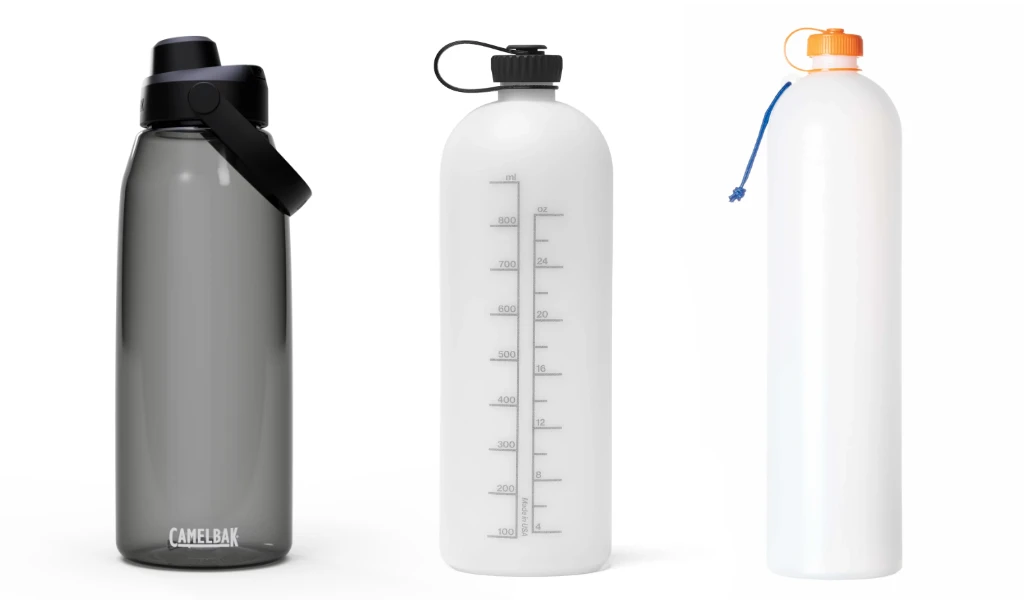
From left to right: CamelBak Chute, Igneous Nobo and CNOC ThruBottle – all with 1 liter capacity. The CamelBak is rigid and has a more “daily” use proposal, but can go on trails. And the other two are semi-rigid and lighter, with the proposal to replace disposable PET bottles on trails.
Transparent or translucent plastic bottles also have another advantage: you can quickly check the amount of water inside them, unlike what happens with metal bottles.
Bottles are great for transporting water, but must remain accessible during use. Avoid placing them inside the backpack or in side pockets that cannot be accessed without someone’s help or without removing the backpack from your back. This can make you stop drinking water regularly because you don’t have easy access to the bottle.
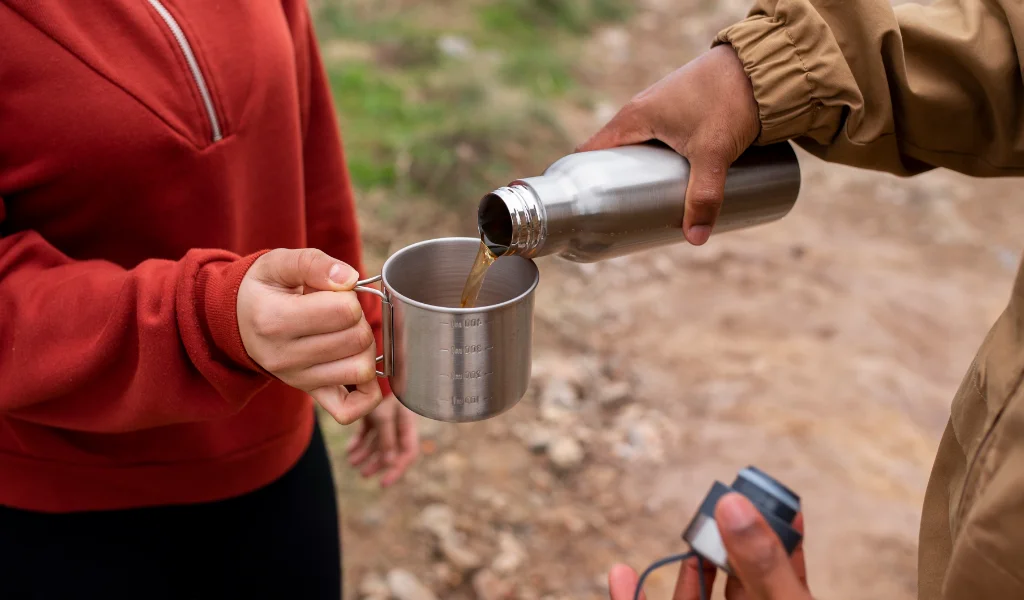
Metal bottles are a more ecological option, as they have simpler recycling. But they are heavier than other options. Photo: Freepik.
Aluminum bottles were left out because this material is not as healthy an option as stainless steel. They are lighter and cheaper than steel ones, but need special treatments or layers on the inside to prevent aluminum contact with water. If you’re going to choose a metal bottle, prefer stainless steel ones. Titanium is also an option, it is safe and lighter than stainless steel – but it is even more expensive.
From an environmental impact point of view, steel or titanium bottles are much better, because these materials can be recycled easily. However, they present the limitations I mentioned above.
I weighed a Thermos 500ml stainless steel thermal bottle and a CamelBak Chute 1 liter. Result: CamelBak 188 grams and Thermos 295 grams. The Igneous and CNOC bottles (shown in the image above) weigh, respectively, 64 g and 90 g.
Main advantages and disadvantages of rigid bottles
Advantages:
- Can be used in other situations (daily life, gym, trips, etc);
- Models with wide mouth (normally 63 mm) are easier to clean and fill;
- Can be used to warm up the sleeping bag (just place the bottle with warm water inside the bag – be careful with water temperature);
- Quality bottles do not leak and are resistant to impacts and falls;
- Many bottles specific for outdoor use allow coupling of water filters, and some are already sold with filters or are compatible with adapters;
- Quality bottles will be free of harmful chemical compounds;
- Are reusable.
Disadvantages:
- Steel models are the heaviest and are not as practical as transparent plastic models;
- The bottle needs to remain accessible during use, otherwise you may drink less water because of access difficulty;
- Some bottles are wider and may not fit perfectly in all backpack pockets;
- Non-standard mouths will not be compatible with water filters or adapters;
- Are heavier than other options;
- Even empty they occupy significant space in the backpack.
Usage indication for rigid bottles
This type of bottle works better on trails, whether short or a bit longer. They can also be used daily, on urban trips and bike touring. A tip: multiple bottles allow you to better manage water during the trail. You can separate one bottle for drinking, another for reserve water and one for cooking at night, for example.
2. Soft flask or “collapsible bottle”
The soft flask emerged as a hydration option for runners who use vests and backpacks with straps that allow fitting them. The great highlight of this type of bottle is in the combination of two characteristics: low weight and compactness.
Recently, I did some short trails using a 500 ml soft flask as a quick-access bottle. It stayed in the side pocket of my attack backpack and worked as an “extension” of the 1.5 L PET bottle that was inside the backpack. I filled the soft flask with water from the larger bottle and used it during the hike. When the flask’s water ran out, I stopped and refilled. This process had some benefits:
1. I managed to maintain regular hydration during the trail;
2. I easily tracked the amount of water consumed;
3. I stopped less than I would if I needed to get the bottle from inside the backpack whenever I wanted to drink.
I weighed the NTK Flask 500 ml that I used on that trail, result: 37 grams.

Backpacks and vests for running normally have pockets on the straps to accommodate one or more soft flasks. Photo: deuter.
In terms of weight and compactness, soft flasks are also much superior to rigid bottles. They can be rolled up when empty, reducing the space occupied in the backpack. Additionally, they are lighter than the bottles I mentioned earlier. But not everything is perfect: soft flasks are more fragile than rigid bottles and handling is not as practical, therefore, choose a good quality model.
If you are a fan of the “do it yourself” idea, try making removable pockets to transport soft flasks (or smaller bottles) on your backpack straps. This adaptation can help you when the backpack doesn’t have side pockets or when access to them during the hike is not so easy.
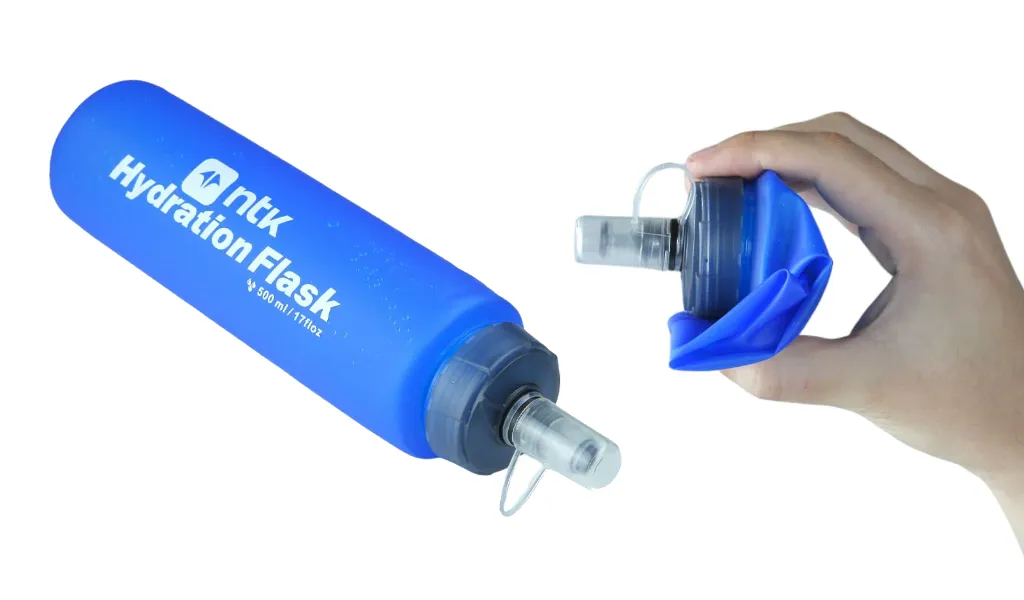
NTK Flask that I used on some short trails in Ilha Grande in December 2025
Main advantages and disadvantages of soft flasks
Advantages:
- Are light and compact;
- Volumes ranging from 250 ml to 1 liter, but there are similar options with more than 3 liters – like some HydraPack models;
- Are transparent, allowing you to track water consumption;
- Are less bulky than rigid bottles;
- Adapt well in narrower pockets or on straps of specific backpacks and vests (smaller volumes);
- Some have caps that protect the spout against dirt;
- Some models allow coupling water filters (in the international market there are models sold with filters).
Disadvantages:
- Handling is not as practical as a bottle;
- Some models have small mouths, which makes cleaning and refilling difficult;
- Are more fragile, can puncture or tear during use;
Usage indication for soft flasks
Soft flasks are versatile, they work very well both in running and on trails. However, as they are more fragile, they should not be used in situations where there is a possibility they will suffer damage due to friction with branches, bamboo, etc. They can be used on bike trips (in vests or backpacks), but handling soft flasks while pedaling is not so practical; and can work on urban trips, as an alternative to rigid bottles or PETs.
Reservoir with hose
Popularly known as “CamelBak” (because of the American brand) or “hydration bladder”, this type of reservoir works well in some sports. It offers a greater water transport capacity than bottles and soft flasks; and the hose allows you to drink water while running, pedaling or walking.
But they have an old “problem”: when using a reservoir of this type you will need an extra bottle if you want to carry a sports drink. Depending on your activity this may not be a problem, but for those thinking about minimalism and weight reduction this characteristic will be a negative point. Years ago a reservoir with two compartments and two hoses appeared on the market, precisely to solve this issue, but the public did not adopt the idea.
Accessibility also deserves attention: the reservoir usually goes inside the backpack, which can make removal difficult for refilling when the backpack is full. Additionally, they can be compressed during the activity (especially in cargo backpacks). In the distant past, I had a bad experience with a low-quality reservoir that burst inside my backpack.
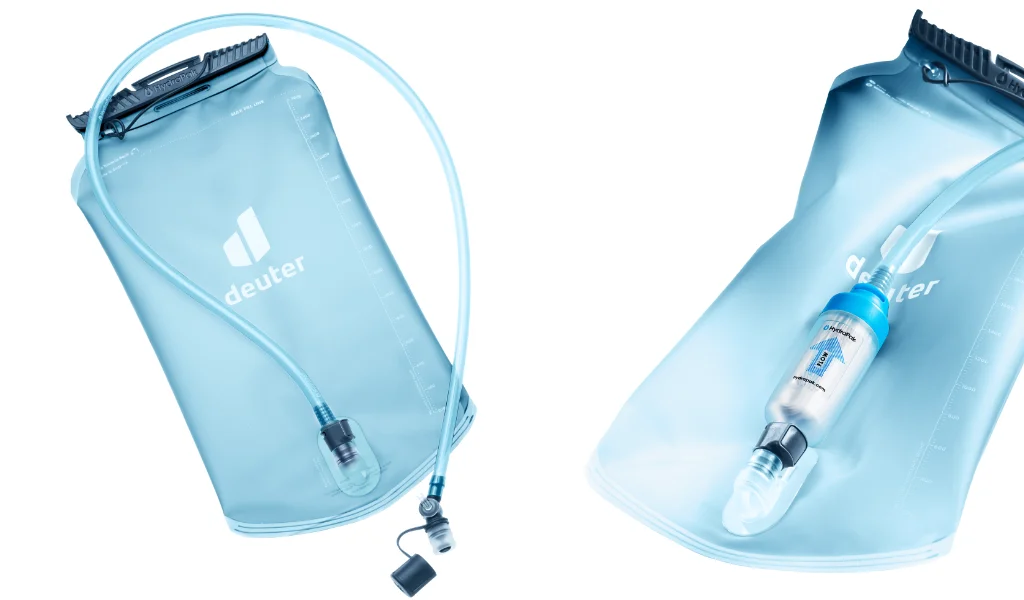
Hydration reservoir from deuter. On the right, image of a Hydrapak filter coupled to the reservoir.
Being a specific accessory, it ends up losing points in usage flexibility. While bottles and soft flasks work on trips and daily life, the reservoir with hose would not be practical in those situations.
Main advantages and disadvantages of reservoirs
Advantages:
- Enables transporting a larger volume of water in a relatively compact container;
- Allows the user to drink on the move with great practicality, it is the most practical option in this scenario;
- Allows coupling specific water filter models to the hose.
Disadvantages:
- Are not as compact as soft flasks nor as functional as bottles;
- Need a backpack with specific pocket to work perfectly;
- More complicated refilling during the trail, it will be necessary to remove the reservoir from the backpack or use a bottle to fill it;
- More laborious cleaning than other options;
- You cannot accurately estimate the amount of water in the reservoir without removing it from the backpack;
- Cheaper models can burst or leak;
- Have more parts that can cause problems – fittings, hose, flow valves, caps and spouts;
- Are not the best option in environments with negative temperatures, where water can freeze in the hose or reservoir.
Usage indication for reservoirs with hose
- On the bicycle: in training, rides, trips or long-duration challenges. I occasionally pedal with a backpack and one of these reservoirs, and when I need to I carry a bottle with sports drink in the bike holder. There are also hydration waist packs with space for specific reservoirs;
- On trails: they work better in attack backpacks or running vests than in cargo backpacks (because of access to the reservoir during the hike);
- In slightly longer activities: when you need to transport more than 1.5 liters of water and want the ease of drinking on the move;
- Trail run and adventure racing: a reservoir with hose can greatly facilitate hydration during movement.
Bike bottle (with or without thermal insulation)
Caramanholas or squeezes, as cycling bottles are also called, can go far beyond use on the bicycle. Volumes reach 820 ml and some have thermal insulation.
The wide mouth and spout that controls liquid flow are interesting characteristics on short trails (where thermal insulation makes more sense). However, on slightly longer trails, insulation becomes a disadvantage. This characteristic adds weight to the bottle and is not justified on multi-day hikes.
I weighed a rigid CamelBak Chute 750 ml bottle (made in Tritan) and a Refactor 710 ml bike bottle with thermal insulation. The CamelBak marked 154 g and the Refactor 125 g, but there are models without thermal insulation that are even lighter. If you already use bottles of this type on the bike, try taking them on a hike. Maybe you’ll discover you don’t need another bottle to use on foot trails.
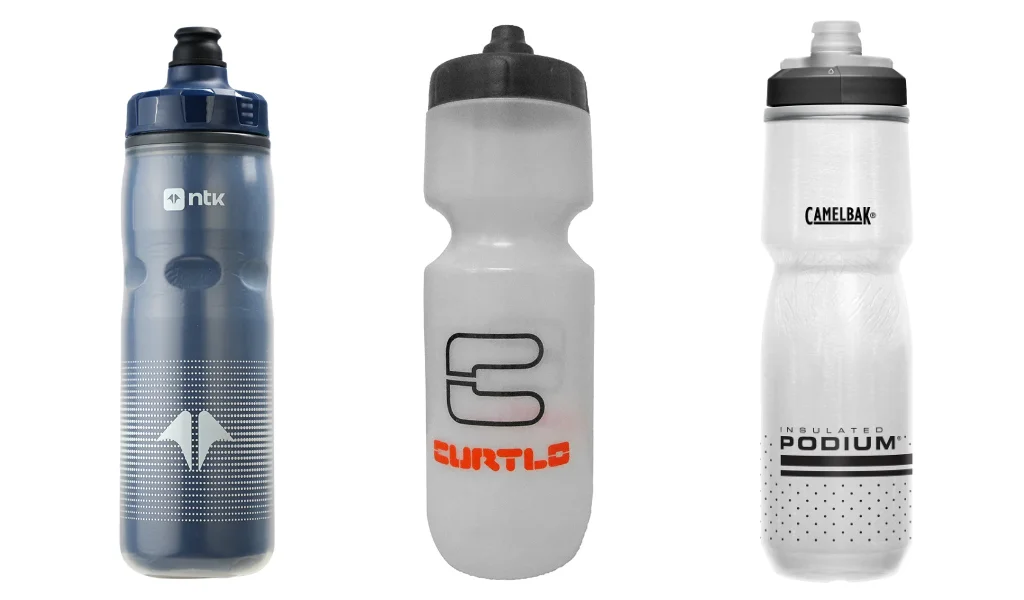
Bike bottles are versatile and can be used in many different situations
Main advantages and disadvantages of cycling bottles
Advantages:
- Capacity between 500 ml and 820 ml, suitable for various types of activity;
- Some are cheaper and lighter than rigid bottles;
- Some models have thermal insulation, an advantage for short-duration sports (where this characteristic makes sense);
- The spout with flow control facilitates hydration with one hand only. It is not necessary to use both hands to open the bottle, as happens with a regular bottle;
- Work for daily use.
Disadvantages:
- Simpler models can leak through the spout, but some more sophisticated models have flow locks that eliminate this problem;
- The bottle’s flexibility can also be a negative point, some models can leak if compressed inside the backpack.
Usage indication for cycling bottles
This type of bottle can work very well on short trails, at the gym, daily and on the bike, obviously.
PET bottles
PET bottles (mineral water or soda) are usually used by hikers to reduce weight in the backpack without spending money. A 1.5 liter PET bottle weighs around 30-40 g, a much better weight-volume ratio than the previous options.
The financial advantage is also obvious, however, they do not last as long as other options, which requires buying a new bottle from time to time. This results in constant generation of plastic waste.
PET bottles are easily found along trails, partly due to lack of common sense by some people and partly because that bottle did not cost much, it is “disposable”. Now think: how many rigid bottles have you found abandoned along the way? Isn’t it worth including a few more grams in your backpack to help reduce plastic waste?
Obviously the bottles we find in the middle of trails were not left by those who have environmental awareness and a notion of minimum impact. But not always a bottle discarded in a trash can after the trail will be effectively recycled. This will depend on collection at the location, if recyclable trash was not mixed with organic waste, etc.
I normally use rigid bottles on trails or trips, but this is not always possible, especially when I travel with a reduced backpack and without checking luggage. When this happens, I opt to buy a 1.5L water bottle that is resistant enough to withstand use during that trip, and I refill this bottle at public water fountains, at accommodation or during the hike. The idea is simple: extend the use of the PET bottle during the trip to not need to buy another bottle, and always discard it at a recyclables collection point after use. But is this idea good?
Disposable PET bottles were created for single uses, the materials were not planned for prolonged use. These bottles can suffer degradation over time and release microplastics into the water. There are several scientific studies that talk about this type of contamination even before reusing the PET bottle, such as:
- Small-sized microplastics and pigmented particles in bottled mineral water
- Characteristics of nano-plastics in bottled drinking water
- Synthetic Polymer Contamination in Bottled Water
This movement to replace disposable bottles is generating debates in the United States too, brands like CNOC and Igneous have reusable bottles and other lightweight hydration solutions that are being considered by some hikers as an alternative to PET bottles.
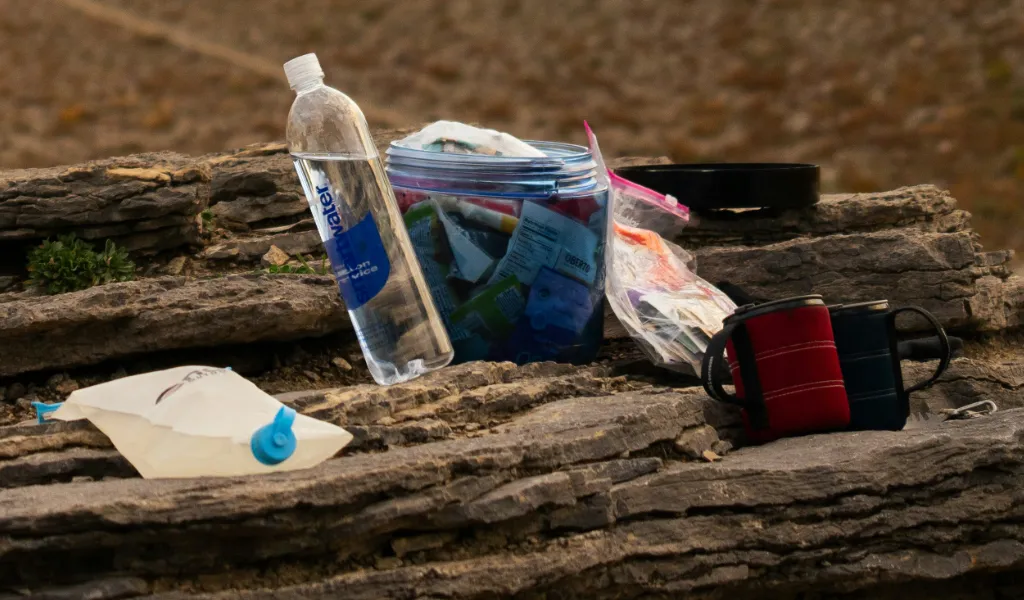
Mixing different solutions is common in outdoor activities. In the image a 1 liter PET bottle next to a water bag from CNOC Outdoors (Vecto 42 mm) / Photo: Alex Moliski – Unsplash
Main advantages and disadvantages of PET bottles
Advantages:
- Light and very cheap;
- Various capacities, including above 2 liters;
- When empty can be crushed to reduce volume occupied in the backpack, but this affects the bottle’s durability;
- Does not usually leak;
- Allows coupling compact filters (28 mm);
- Possibility of using bottles with different capacities while maintaining low cost.
Disadvantages:
- Generation of plastic waste;
- Low durability if compared with other options for transporting water;
- Not every bottle fits in backpack side pockets;
- Narrow mouth makes refilling during the hike difficult and does not facilitate internal cleaning;
- Should not be used for prolonged periods because of the risk of chemical contamination from plastic degradation or biological contamination from lack of adequate cleaning.
Usage indication for PET bottles
If you are concerned about environmental issues and the presence of microplastics in water, consider using the PET bottle in situations where you have no other solution to transport water. After use, give the bottle a proper destination.
Other ways to transport larger volumes of water
I do not intend to go into details, but there are several accessories for those who need to carry more water in activities, solutions that serve expeditions, large groups or people traveling by car, bicycle, motorcycle, kayak…
From cheaper products like collapsible reservoirs of 5 liters (or more) to more technical products, like WaterCell-type reservoirs from Sea to Summit or similar. Each with its target audience and usage indication.
There are lighter options too, like the containers from CNOC Outdoors, which are more interesting for those who want to reduce a few grams in backpack weight.
But which is the best option for hydration?
The answer is simple: it depends on your usage profile. There is no universal solution that serves 100% of people in any activity.
The idea of this text was to put on the “table” all the most common alternatives for water transport in outdoor sports, without leaving aside the possibility of use in daily life and on trips. Buying equipment that can be used in multiple situations is a smarter investment. Comparing this information and doing your own research you will be able to choose the best option for your use.
Another important point is sustainability. Not always choosing the lightest and cheapest will be the best long-term solution. You solve the problem quickly, but what about after? Will your choice end up in the ocean or in landfills? This questioning applies to all other items I mentioned in this text. Make conscious choices and do not buy “unnecessary things” that will be thrown in a box in your garage or in the junk room.
You can even look in the kitchen cabinet, who knows there might be some “forgotten” bottles there that could be used, resold or donated.
Fair winds!
This post is also available in: Português (Portuguese (Brazil)) Español (Spanish)