

A adventure racing brings together different modalities, such as Trail running, mountain bike, and canoeing, and represents an invitation for those who wish to challenge themselves and evolve in nature activities. However, spending hours in natural environments requires physical conditioning and technical preparation. In this article, Shubi Guimarães, one of the main female references in adventure racing and founder of Equipe Atenah, shares her experience and gives tips for those who want to start in the modality.
With 35 years of participation in races in different parts of the world, the athlete is one of the characters in the book “Mulheres na Natureza: Práticas, inspiração e acolhimento nas atividades ao ar livre”, which will be released soon by Gear Tips.
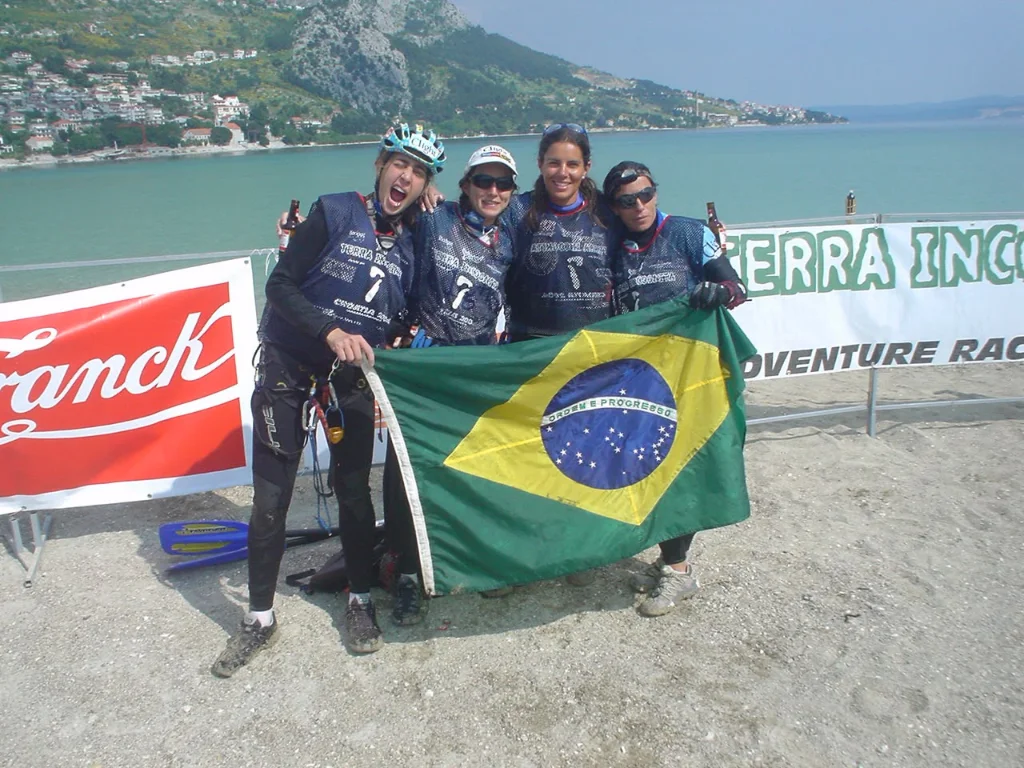
Atenah in Croatia, in 2004, by winning 4th place in Terra Incognita. place in Terra Incognita
Seek specialized professional guidance
Although it is a personal choice, it is important that the professional knows, even minimally, adventure racing/strong>. Today, there are sports consultancies with experience in Trail running and adventure sports that, more than just adapting a conventional running workout, know the specific demands of the modality and know how to prepare the athlete for the situations they will find off the asphalt.
The most important thing, according to Shubi, is to establish a joint construction: you present your demands, goals, and difficulties, and the coach recommends the best strategies, considering, including, the strengthening of the joints and the muscle groups most demanded in outdoor activities.
Cardio or strength training: what is the priority?
For adventure racing, it is fundamental to develop good physical conditioning to be able to remain moving for six, eight, or even 24 hours. Therefore, the first step is to leave the car aside, whenever possible, and travel on foot. Walking already contributes to building endurance.
Cardiovascular stimuli should be daily, respecting the body’s signals and the necessary recovery periods. In the absence of easily accessible trails in the city, part of the training can be performed on asphalt or in the gym, using a treadmill, stationary bike, and other equipment. Street running plans put together by sports consultancies help keep the workouts up to date.
But remember that contact with nature is fundamental to develop specific skills and gain familiarity with different types of terrain. Even if these workouts happen on weekends, walking and running on trails prepares the body for the real demands of an adventure run.
Although cardiovascular conditioning plays a central role, Shubi reminds us that strength training is also indispensable and should be part of the routine, at least twice a week, considering the characteristics and age of each athlete. As the years pass, preserving muscle mass and strength becomes even more important.
Mountain Bike: more technique and less strength
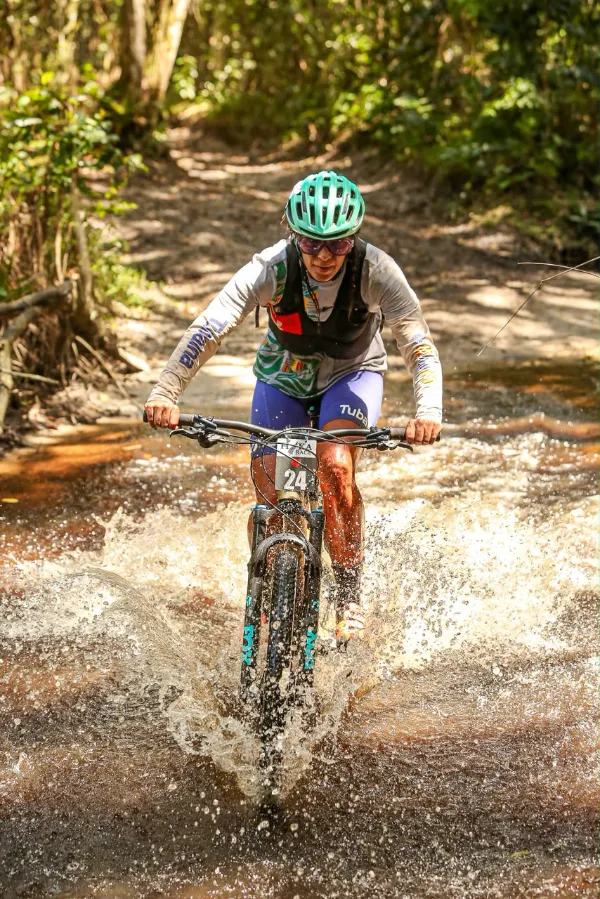
In mountain bike, technique stands out over strength
M astery of mountain bike technical skills was one of the characteristics of the Atenah Team and one of the factors that gave the athletes an advantage over other teams:
“We had a history of entering technical sections, with lots of rocks, water, and sand, and, even being a women’s team, passing everyone. Sand, for example, might seem simple to an outsider, but knowing how to ride on sand represents a huge advantage. It is much more a matter of technique than of strength.”
Technique begins with basic knowledge about your own bicycle. Do you know, for example, what the function of each brake is? This is a question that Shubi often asks many adults, and many times, she is left without an answer.
“The front brake, operated by the left hand, is primarily responsible for stopping the bike. The rear brake, operated by the right hand, helps reduce speed and can cause a skid, but alone it probably won’t be enough to stop the bike,” Shubi explains.
You also need to learn how to position your body according to the terrain, how to pedal uphill and downhill, identify your dominant foot, and understand which position is safest for descending standing up on the bike. Correctly positioning your torso, controlling the steering, and knowing where to place the front wheel in mud, grass, holes, rocks, and other obstacles are basic skills for anyone who wants to develop in the sport.
Just like in trail running, conditioning can be worked on at the gym, including spinning classes, but it is essential to have specific training, especially on weekends.
Canoeing: how to improve techniques
According to Shubi, canoeing is usually the least-trained modality in adventure racing and, historically, Brazilian teams face more difficulty in this stage. Even so, it is important to develop at least the basics of technique and conditioning.
For those who are starting, the first step is learning how to use the paddle correctly. A good option is to look for a canoeing course on the beach, when possible, or in clubs that offer the modality in your city. Since it is not always possible to train in the water, strengthening the upper limbs at the gym can help maintain conditioning.
In addition to the specific technical skills of each modality, knowledge of orientation and navigation in natural environments is fundamental in adventure racing. Therefore, it is recommended to participate in specialized courses, such as the Orientação e Navegação em Ambiente de Montanha (CONAM).
To stay motivated, follow 5 tips from Shubi Guimarães
1. Love the process on good and bad days: training is also about learning to respect the body’s different moments. There are days when you feel strong and others when you feel tired or weaker. Understanding that rest is also part of the process and that, after it, the body can respond again is fundamental.
2. Maintain consistency: the more you train your body and mind, the more prepared you will be to face the challenges of an adventure race. Evolution happens through repetition and continuity, not just during the most intense workouts.
3. Find your motivation and turn it into discipline: motivation is what makes you get out of bed, put on your shoes, and head out for a workout. Therefore, it is important to have clarity about what drives you to want to participate in an adventure race and keep that goal present.
“I am 50 years old and have been participating in competitions for 35 years, which has made my mind well-trained. Even when I wake up tired, I know that if I go out for a run, I will feel much better afterward,” says Shubi.
4. Sleep well: good nights of sleep are essential for the recovery of the body and mind, especially during preparation for a race.
5. Cultivate good relationships: empathy, charisma, and the willingness to build good relationships are also part of the preparation. Having people around who support, encourage, and share good energy can make a difference during the process.
After all, when we build a support network, we create a more favorable environment to achieve great results.
Este post também está disponível em: Português (Portuguese (Brazil)) Español (Spanish)