
In remote areas, having a reliable means of communication is essential to deal with unforeseen events and emergencies, ensuring quick support, safer decision-making, and risk reduction. Quite popular in Europe and the United States, radio communicators still face resistance from outdoor activity practitioners in Brazil. Among the main reasons are the lack of information and education about the use of the equipment and the perception of high cost, although accessible options already exist in the market.
At the same time, the debate about the efficiency of alternative means of communication in areas without cell phone signal has been intensifying when the subject is safety and risk reduction, especially after recent cases such as those of Roberto Farias, Juliana Martins and many others.
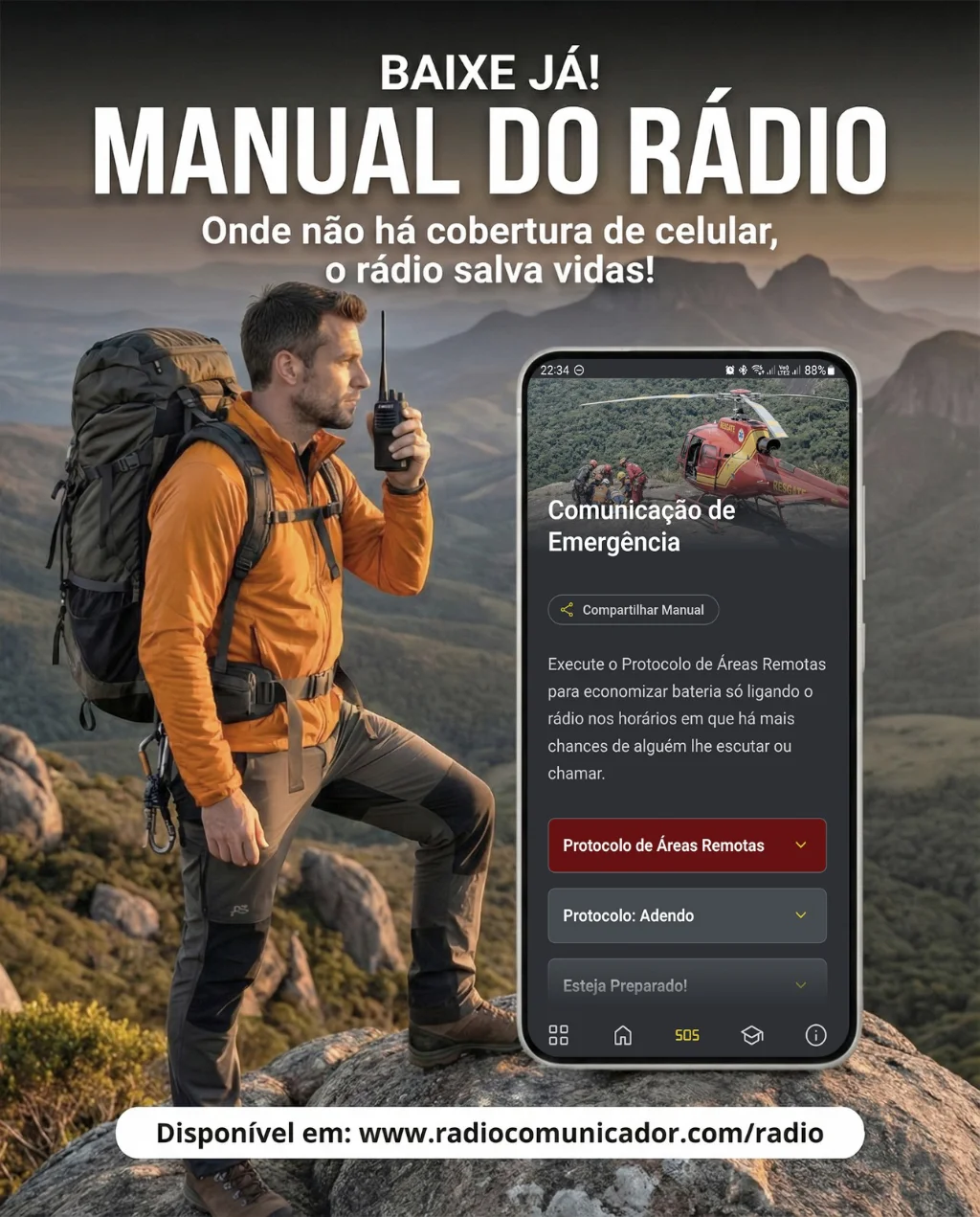
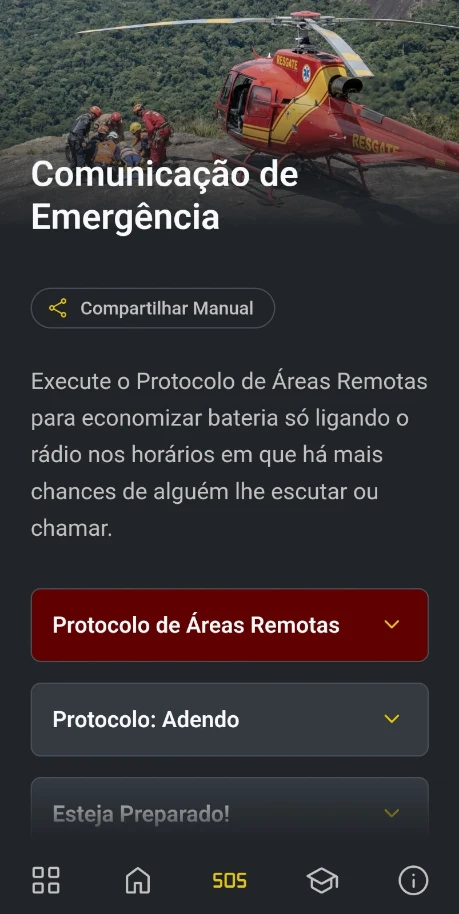
It is in this context that the work of Marcio Grassi Salvatti fits in, who since 2021 has been working alongside a group of fellow radio amateurs in raising awareness and disseminating knowledge about the correct use of radio among outdoor activity practitioners. In 2025, the group launched the application Manual do Rádio, a quick reference guide on legislation, ethics and operational technique, with the objective of popularizing the general use radio communication service and making it more accessible to everyone.
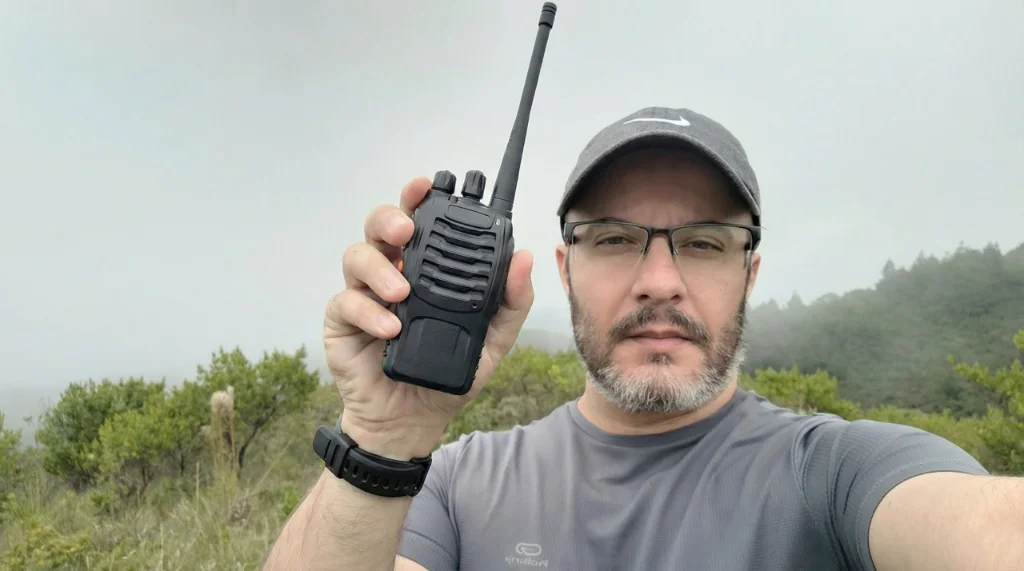
“We created WhatsApp groups to debate the possibilities of communication in remote areas, beyond commercial satellite service, which can be complex and expensive for most people. When we found ourselves in limbo, we discovered the conventional radio communicator and started to investigate and study the general use radio communication, which is simpler”, says Marcio.
The professional acts as coordinator of the Radio Communication Service of Associação Trilha Transmantiqueira, is an honorary member of the Liga de Amadores Brasileiros de Rádio Emissão, and is a radio amateur certified by Defesa Civil and by the American Radio Relay League (ARRL).
General use radio communication: the gateway
When we talk about radio communication, there are two types of services: general use radio communication and the radio amateur service, more technical, complex, and bureaucratic, indicated for those who wish to specialize.
For outdoor activity practitioners seeking safety, general use radio communication is sufficient, according to Marcio. It does not require qualification, authorization, or a license, nor in-depth knowledge about frequencies, a factor that often keeps people away from this solution. Still, like any equipment, the radio communicator must be studied and tested before being used on trails and in remote environments.
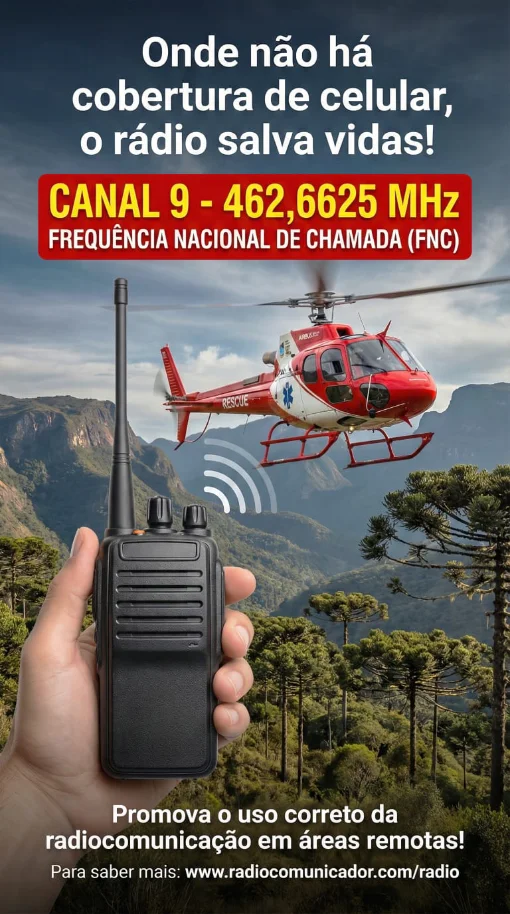
General use radio communication uses simple radios, easy to operate, with 16 or 26 channels. In case of eventualities, just select channel 9, the meeting frequency used for emergencies, and follow the remote areas protocol available in the Manual do Rádio, which should be studied in advance.
“We elected channel 9 in general use radio communication as the national calling frequency (FNC) and emergency frequency, which facilitates communication for people who don’t know which channel to use. For now, this is a convention that is not yet included in Anatel regulations, but is in operation. If you are with your radio in a remote area and know the protocol, you can activate channel 9. People who receive information about the incident will enter the same channel and begin to operate the communication.”
For this to happen more efficiently, as we have already highlighted in other articles about safety, it is essential to share the itinerary with family, friends and also with those responsible for the place where you will be staying before departing for the trails. This practice facilitates decision-making and speeds up search and rescue actions when necessary.
The emergency service announcement was communicated at the end of 2024, in the e-book Manual do Serviço de Radiocomunicação. Marcio states that, since then, there are several reports on social media of people using the service.
Who will receive my communication?
Unlike the paid service provided by SPOT X, for example, which by activating the SOS button sends, via satellite, information and coordinates to a specialized rescue center, the general use radio communication network works in a decentralized way. When activating the emergency service, people involved in the rescue, equipped with radio, can create a temporary and responsive network on site.
Marcio explains that in the recent case of Roberto Farias, lost on Pico Paraná, the searches could have been shortened if he had been carrying a radio communicator. “The Corpo de Bombeiros was the first to arrive, according to reports. After that, many volunteers appeared, including radio amateurs. If the radio had been present from the beginning, it would have accelerated communication between everyone, since the cell phone was failing in the location.”
Who should use the service?
All people who frequent trails and mountains in areas without cell phone signal. According to Marcio, the general use radio communication service is an accessible alternative to commercial satellite service and is available free of charge to everyone.
“The sporadic visitor generally does not hire satellite services and cannot be left in communication limbo in remote areas. Today, this is the most viable solution. That’s why it’s important to viralize this awareness campaign. Radio is prevention, and we need to overcome this deficit.”
In addition to outdoor activity practitioners, Marcio’s effort also seeks to mobilize parks and search and rescue teams to adopt this prevention and rescue standard in areas without cell phone coverage, a movement that is already beginning to gain strength in places like Parque Nacional de Itatiaia, in Rio de Janeiro.
He also highlights that the inclusion of the National Calling Frequency (FNC) on signage for Long Distance Trails, flight ramps and adventure areas is fundamental to expand the safety of practitioners. Likewise, the integration of firefighters and other public security agencies into this network is essential to expedite service to the population in search and rescue operations.
Why adopt general use radio communication
- Indispensable for safety: acts both in prevention and in rescue in areas without cell phone signal.
- Simplicity: uncomplicated, intuitive, low-cost and accessible equipment.
- Without bureaucracy: dispenses with license, qualification or authorization. Still, it is essential to know the Remote Areas Protocol and channel 9, the National Calling Frequency. Access to the Manual do Rádio application is an essential part of this process.
- Available models: manufacturers like Motorola and Intelbras offer simple models, such as the Motorola Talkabout T110BR, Motorola Talkabout T470, Intelbras RC 3002 G2 and the Intelbras RC 4002. Marcio also highlights the cost-benefit of Aquário, a Brazilian brand that provides more accessible options to the public, such as the Rádio Portátil Easy Talk.
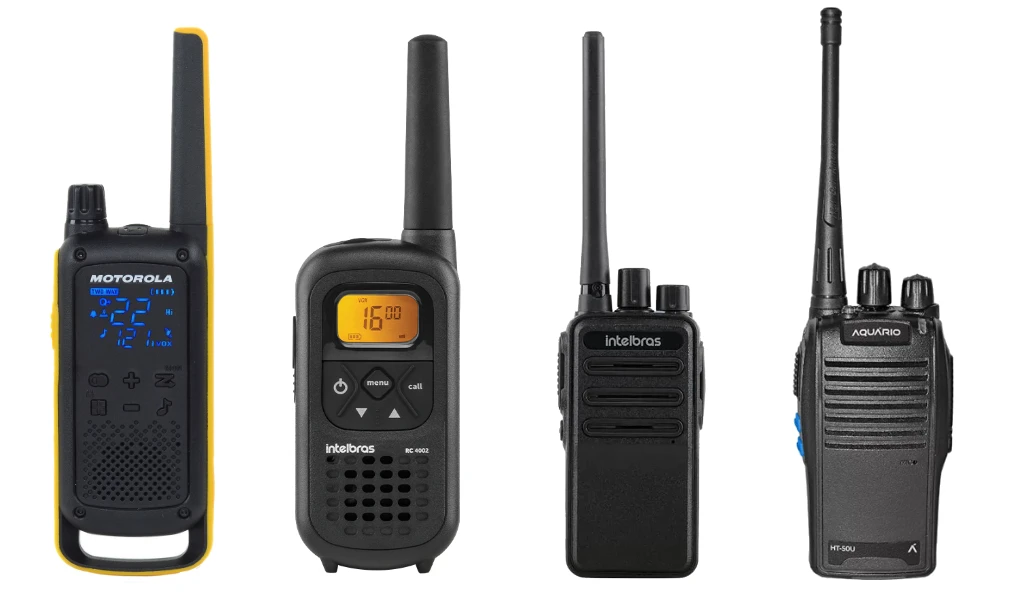
Some of the radios mentioned above (from left to right: Motorola Talkabout T470, Intelbras RC 4002, Intelbras RC 3002 G2 and Aquário Easy Talk)
What about the radio amateur service?
Unlike general use radio communication, the radio amateur service is aimed at more experienced operators who are passionate about technology and radio communication. It is frequently used by groups such as Defesa Civil, scouts, and volunteers in emergency situations.
- Profile: technical and specialized service, also practiced as a hobby.
- Requirements: requires qualification and a license from Anatel — the process includes theoretical and practical tests, as occurs in obtaining a driver’s license.
- Equipment: more powerful and complex, operating on frequency bands distinct from those of general use radios.
- Safety: regulatory requirements exist to ensure responsible use of frequencies and transmission power.
- Active network: the Manual do Radioamador application gathers useful information, such as a social network in which operators share and map repeaters throughout the country.
We support the awareness campaign about the correct use of radio communicators in remote areas and invite not only outdoor activity practitioners, but also parks, inns, hostels, and other services that receive visitors in trail regions to adopt this initiative.
Access to information, the implementation of safe practices, and the construction of support networks are fundamental to ensuring safer experiences for all of us.
This post is also available in: Português (Portuguese (Brazil)) Español (Spanish)