

The newly inaugurated National Trail of the circuit around Rio (Trilha Nacional Volta ao Rio), the largest ecotourism circuit in the state of Rio de Janeiro, spanning 3,500 km, welcomed its first hiker: long-distance trail veteran Luiz Aragão. Over roughly four months — 127 days of actual activity out of the 131 he spent away from home — Luiz covered 2,200 km on foot, by bicycle, kayak, and caiçara canoe.
The state’s new long-distance trail passes through more than 50 municipalities. Aragão’s starting point was Parque Nacional da Tijuca, on May 1, 2026. The volunteer’s goal, having completed the expedition on September 8, 2026, was to test the route and logistics so that other people can, in the future, hike the circuit around Rio safely and with proper planning. In July 2025, Luiz Aragão was also the first to hike the Trilha Transmantiqueira, carrying out similar work.
“We assessed possible camping areas, lodging, places to eat, pharmacies, markets, transportation, and other support services. This survey is essential both for those planning to cover small stretches and for those wanting to hike large sections or complete the entire circuit,” says Luiz.
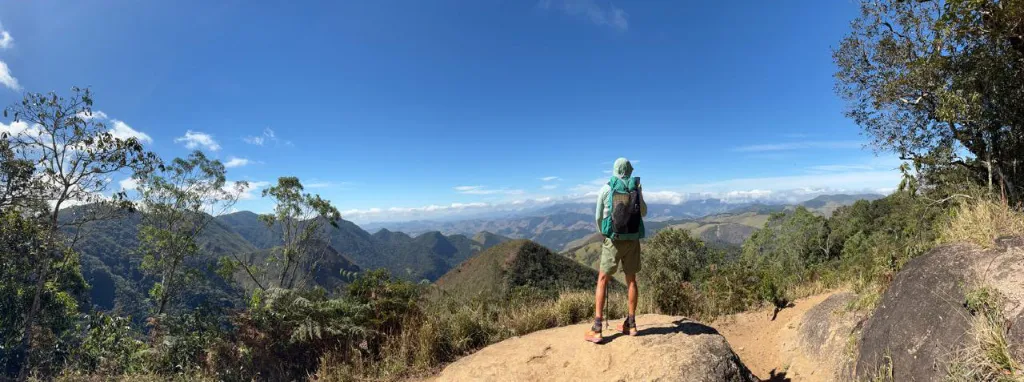
Parque Nacional da Serra da Bocaina
Passing through protected areas such as Parque Nacional da Serra dos Órgãos, Parque Estadual dos Três Picos, Parque Nacional do Itatiaia, Parque Nacional da Serra da Bocaina, and nearly 100 conservation units, the Minas Gerais native, who lives in Taubaté (São Paulo), found a diversity he hadn’t imagined.
“I mainly knew the capital. After crossing the state on foot, by bike, and by paddling, I discovered a diverse state, with mountains, ranges, valleys, rural areas, forests, rivers, lagoons, beaches, and cities. Every change in surroundings felt like a new Rio de Janeiro. The transitions between the mountain region, the north coast, the Serra da Mantiqueira, the Vale do Paraíba, the Serra da Bocaina, the Costa Verde, and the capital stood out,” explains Luiz.
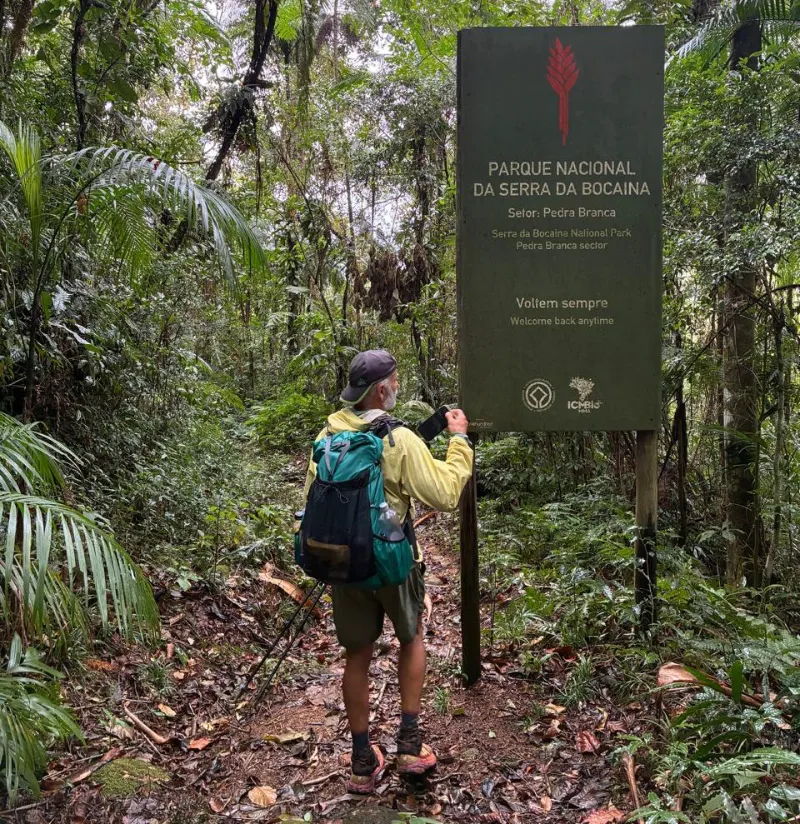
Luiz Aragão at Parque Nacional da Bocaina
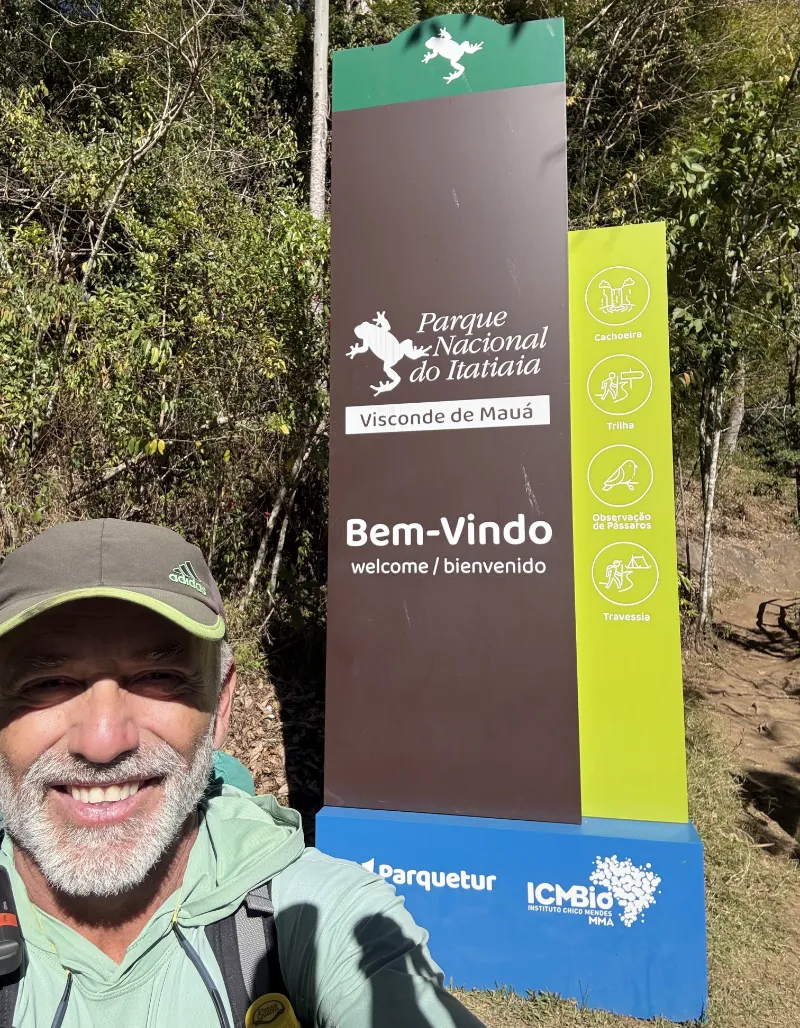
Passing through Parque Nacional do Itatiaia
The volunteer also highlighted how safe the experience felt, as well as the hospitality and solidarity of the people of Rio de Janeiro state, who opened their homes to share meals. By the end of the 2,200 km, Luiz’s baggage carried an extra dose of optimism and faith in human relationships.
The expedition reinforced for Aragão the importance of trails as tools for bringing people closer to nature, for raising the value of conservation units, and for supporting conservation and landscape-connectivity initiatives.
Challenges of the circuit around Rio
Accustomed to covering long distances on foot and camping self-sufficiently, his biggest challenge was integrating hiking with the other modes of travel, in which he had less experience.
“The biggest psychological challenge was navigating the Rio Imbé and the lagoon systems to reach the coast. It took about five or six days of paddling alone, crossing places I only knew from satellite images and camping at previously studied points, which demanded a lot of attention, experience, and emotional balance. When I reached the coast and realized everything had gone well, I felt an enormous sense of accomplishment,” he details.
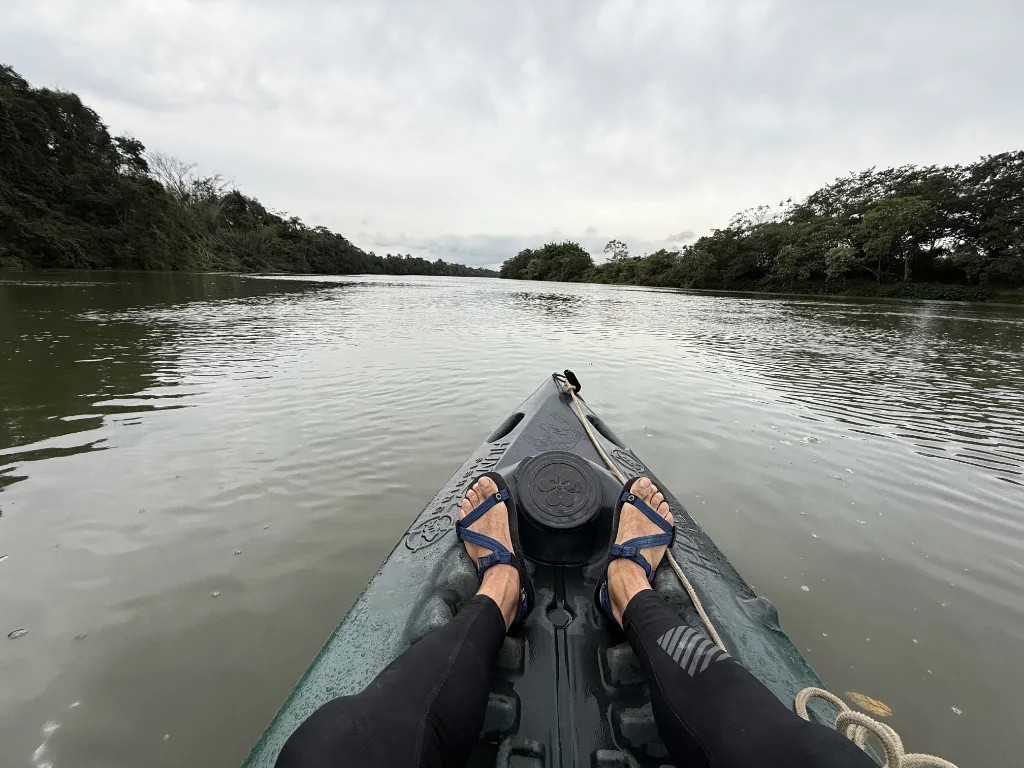
Navigation was Luiz Aragão’s biggest psychological challenge
The biggest physical challenge, on the other hand, came on the bicycle, on the climb between the Vale do Paraíba and the higher stretches of the Serra da Mantiqueira, near Parque Nacional do Itatiaia, due to the significant elevation gain that made the section especially demanding.
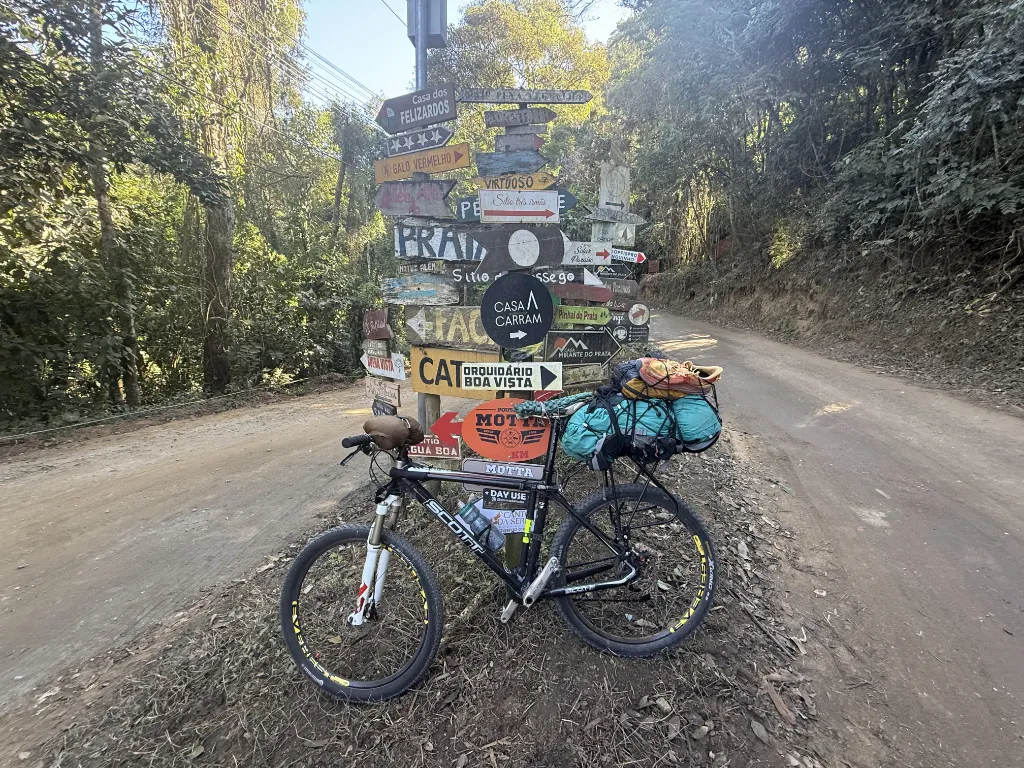
Road between Paty do Alferes and Araras – Petrópolis
The circuit around Rio connects other well-known trails
Conceived and jointly managed by the Rede Brasileira de Trilhas, together with partner institutions and with the active participation of the governance bodies of the member trails, the circuit around Rio is a multimodal circuit linking federal, state, and municipal conservation units.
The new long-distance trail can welcome anyone from those interested in a weekend outing to trekkers prepared for a journey of several months. That’s because the circuit around Rio is not a single, continuous, uniform trail. It links together several already well-established trails that are now part of the Rede Brasileira de Trilhas, such as the Transcarioca, the Transmantiqueira, the circuit of Ilha Grande Island, the circuit of the Waters, in Rio Claro, among others.
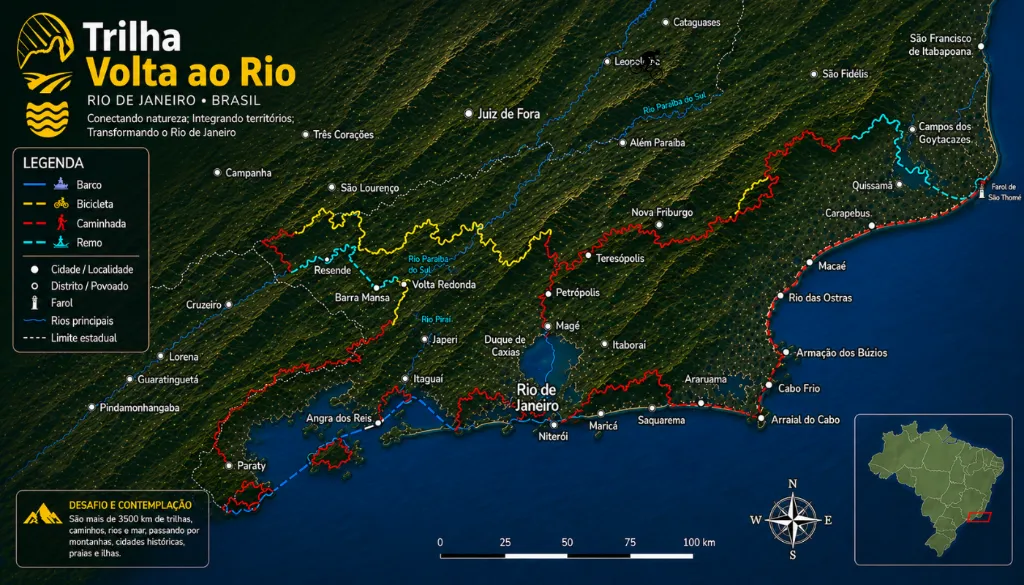
Map of the Volta ao Rio
According to Hugo de Castro, general coordinator of the the circuit around Rio, the ultimate goal is to connect all 92 municipalities of Rio de Janeiro state through the trail network.
“The test expedition carried out by Aragão was the kickoff that has already mobilized more than 50 cities and keeps attracting new municipalities every day. We want to give visitors options so they can build their own circuit and discover Rio de Janeiro through new paths,” he explains.
The expectation is that the “National Trail of he circuit around Rio” (Trilha Nacional Volta ao Rio) will establish itself as the state’s leading nature-tourism product (and one of the most significant in Brazil), positioning Rio de Janeiro as an international benchmark in sustainable tourism.
Beyond the tourism and economic potential for the municipalities involved, the trail’s consolidation also serves as a valuable environmental conservation tool, creating ecological corridors between parks and helping with environmental monitoring in isolated areas of the state.
The circuit around Rio is an initiative carried out jointly with the Instituto Chico Mendes de Conservação da Biodiversidade (ICMBio), the Instituto Estadual do Ambiente (Inea), and the Companhia de Turismo do Estado do Rio de Janeiro (TurisRio), with support from the Ministério do Meio Ambiente, the Ministério do Turismo, and the local governments that have joined the initiative.
This post is also available in: Português (Portuguese (Brazil)) Español (Spanish)